- Beyond the Story by Epaphra
- Posts
- This Is Why Games Pull You In
This Is Why Games Pull You In

Epaphra T
January 02, 2026

Hey Beyonder!
I noticed something weird last week.
I spent three hours playing a game I just downloaded. When I finally looked up, I thought: "Why did this pull me in so fast?"
Most videos I watch? I scroll away in 30 seconds.
But this game? I couldn't stop.
Here's what hit me: The game never explained anything upfront. It just dropped me into the world and said "figure it out."
And that made all the difference.
The Problem With Most Content Today
We try to explain everything immediately.
"Here's what this is about." "Here are the three reasons why." "Let me walk you through my five-step process."
Nothing wrong with clarity. But here's what happens:
People consume your content. Then they forget it.
Because when you explain everything, there's nothing left to experience.
What Video Games Understand (That We Don't)
Games don't hand you a manual first.
They don't start with a lecture about how everything works.
Instead, they drop you into a strange world. You don't know where you are. You don't know what to do.
You just start moving.
And slowly, you figure things out.
You try things. You fail. You learn. You get small wins.
That process? That's what creates the emotional pull.
Compare that to most content:
Everything is explained upfront
Everything is summarized
Nothing is left to discover
The result? People read it and move on. No real impact.
How to Apply This to Your Stories
Here's the framework games use (and how you can use it too):
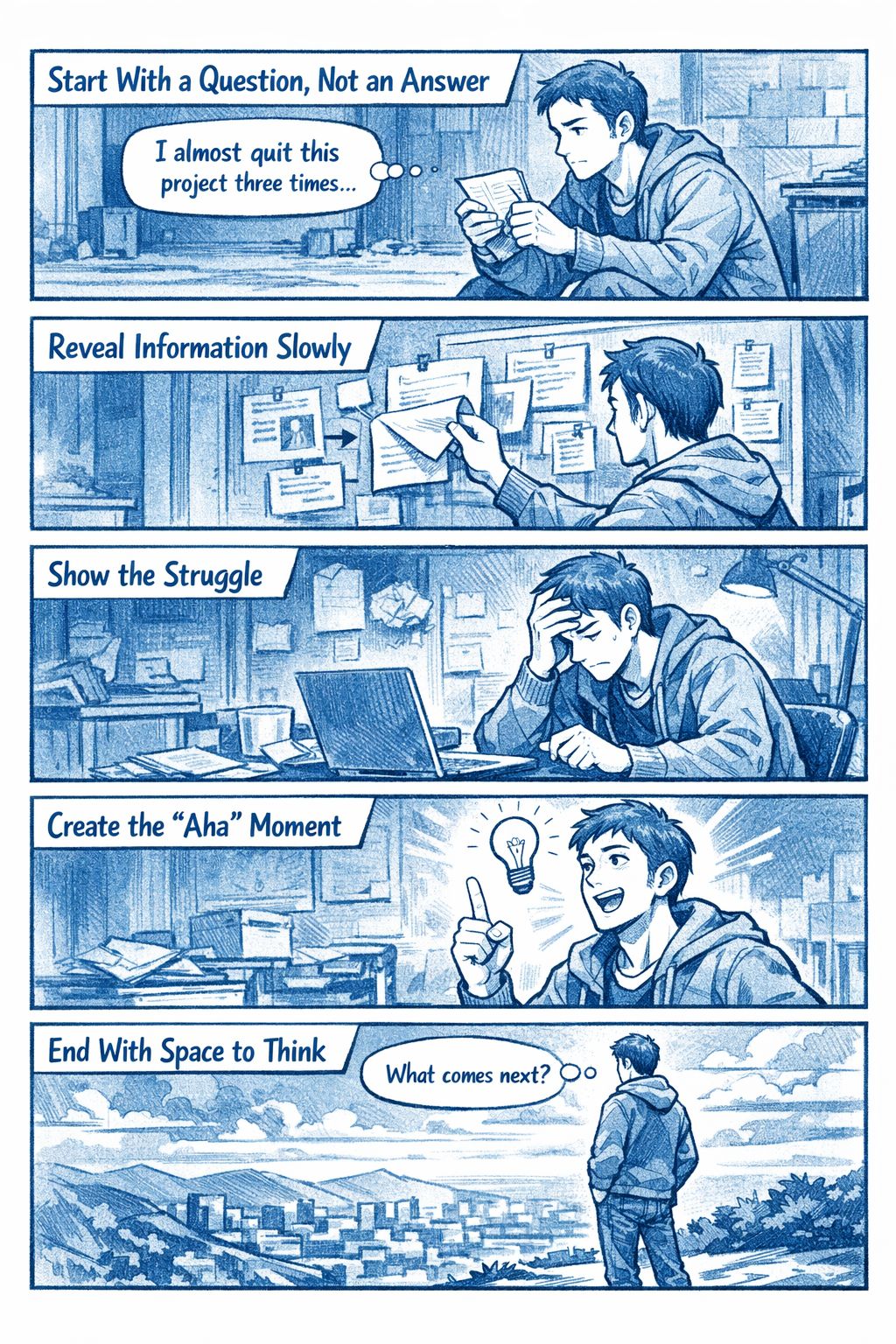
1. Start With a Question, Not an Answer
Don't explain your point in the first line.
Open with tension. A mystery. A moment that makes people curious.
Example: Instead of "Here's how I built my business" Try "I almost quit this project three times before it worked."
Let curiosity pull them forward.
2. Reveal Information Slowly
Games give you information as rewards. Your story should too.
Don't dump everything at once. Build it layer by layer.
Each paragraph should earn the next one.
This keeps people engaged. They're not just reading — they're discovering.
3. Show the Struggle
Games are fun because they're hard.
Stories work the same way.
Don't hide your mistakes. Don't skip the confusing parts. Don't make everything sound easy.
Friction is what makes it real.
4. Create the "Aha" Moment
Every good game has a moment where things click.
Your story needs this too.
It's the insight. The realization. The pattern you discovered.
This is where your reader feels smart. And that feeling? It sticks.
5. End With Space to Think
Great games don't close every loop.
They leave room for you to explore.
End your story with a question. A challenge. A new way to see things.
Keep it alive after they finish reading.
Why This Actually Works
Our brains like progress more than perfection.
We remember experiences better than information.
We learn more when we participate, not just consume.
Game-style storytelling matches how we naturally learn.
That's why it sticks.
Your Turn (Try This)
Take something that happened to you recently.
Rewrite it using this structure:
Start with confusion or tension (not the lesson)
Show how you discovered things step by step
End with the insight you found
Don't explain it. Let the reader walk through it with you.
Final Thought
The best storytellers don't teach directly.
They create experiences that teach themselves.
That's the power of the Gaming Narrative Framework.
What's one story you could tell this way? Hit reply and let me know.
Keep telling stories,
Epaphra